Quiz mit Tim Horus, das ich nicht fast vergessen hätte (ups)
Schulquiz mit Tim Horus: 12 Klassen, viele Fragen und ein Zeugnis


Transkription
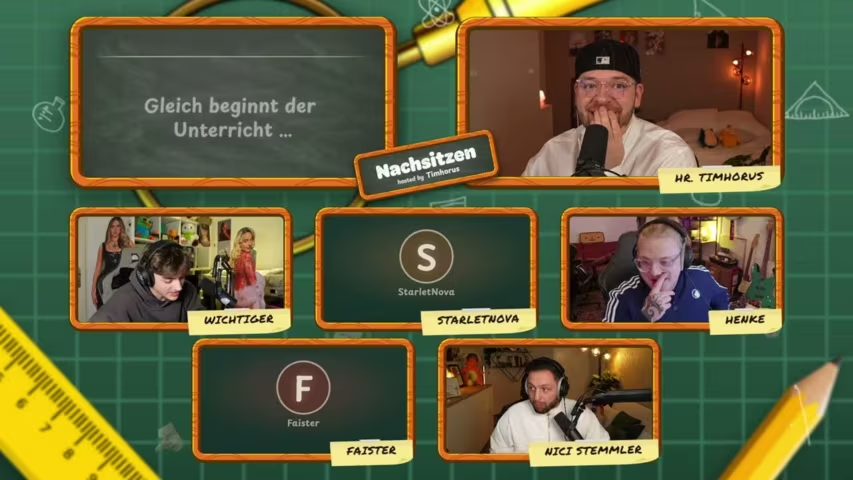
Das Quiz umfasste zwölf Klassen mit unterschiedlichen Themen. Von einfachen Rechenaufgaben über Geographie-Fragen bis hin zu kniffligen Details wie der Anzahl der Herzkammern wurde alles abgefragt. Einige Antworten führten zu Diskussionen, etwa über die korrekte Reihenfolge der Planeten oder die Definition von Superlativen. Die Teilnehmer zeigten unterschiedliche Stärken, und am Ende wurde ein Zeugnis mit Durchschnittsnote ausgestellt. Die Veranstaltung war geprägt von Spiel, Spaß und Lernmomenten.

Just Chatting
Ankunft und Vorbereitung des Quiz
00:06:00
The stream begins with greetings and a humorous story about a scammer posing as a Telekom employee at the door. The quiz leader talks about a watermelon-Nutella trick and shares links for the participants to set up their digital whiteboards. They explain the rules of the school quiz called "Nachsitzen", including the points system, the ability to copy answers, and the requirement for each participant to give a speech on an unpopular opinion. The setup ensures everyone has the correct tools and audio, with a brief test of the monitoring system.
Klasse 1: Bonbons, Monate und die Feuerwehr
00:24:20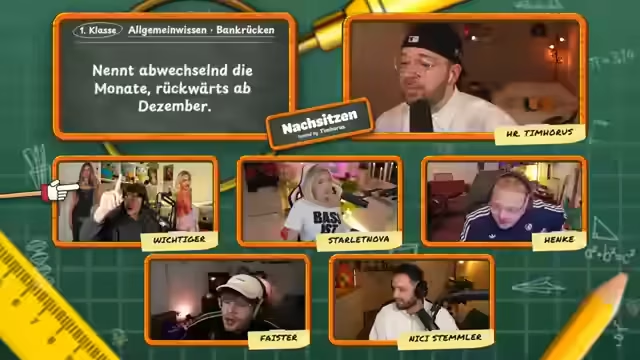
The first class starts with a straightforward math question about how many bonbons Lisa has after giving away two and receiving four. The answers are collected via digital whiteboards, with some participants struggling with simple arithmetic. Then they move to general knowledge about the month with the fewest days, and finally a safety question about dialing the fire department in Germany. The quiz leader uses a timer for each question and jokingly gives a half point for a minor infringement, highlighting the playful yet competitive atmosphere of the session.
Klasse 2: Verkehrsregeln und Kettenrechnen
00:33:14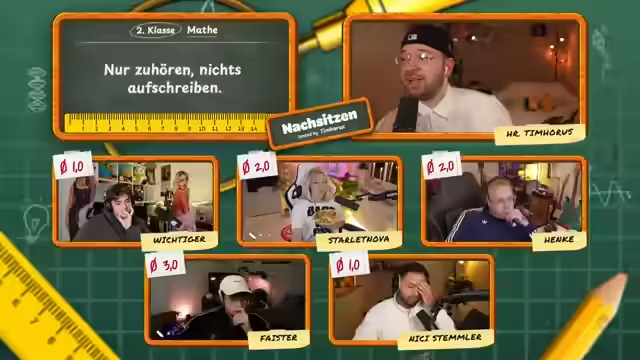
In this class, the participants are asked which side of the road one drives on in Great Britain, leading to a debate about the correct answer. The second question is a math problem involving a "chain calculation" (4*3+8/4*10), which causes confusion about the order of operations. The quiz leader explains point-before-line rule, but some participants still get it wrong. The session ends with a team task where they have to name the months in reverse order, with one participant being eliminated early, showing the increasing complexity and engagement of the challenges.
Klasse 3: Länder, Sprachen und Planeten
00:46:17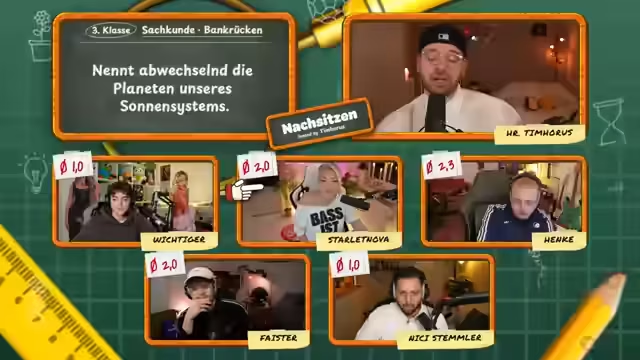
In this class, they identify a country on a map (Italy), then translate "Eichhörnchen" into English, with one participant mentioning they discussed it in their podcast. They also name the planets of the solar system in order, and there is a debate about whether Pluto counts. Finally, they tackle the conundrum of the correct article for "Nutella", where all three possibilities are accepted according to the Duden, leading to extra points for a clever answer. This class mixes geography, language, and logic, encouraging out-of-the-box thinking.
Klasse 4: Himmelsrichtungen, Kunst und Farben
00:54:05
The class opens with a geography question about the opposite direction of southwest, which is answered correctly by everyone. The arts question asks them to paint the French flag, but the available colors are limited, causing complaints about missing blue and red. They also mix primary colors to get secondary colors, with one participant drawing a proper color wheel. A rounding task (2550 to the nearest hundred) leads to confusion about whether to round up or down, causing a lively discussion about mathematical rules and the fairness of grading.
Klasse 5: Tiere, Knochen und Berge
01:02:24
The first question is about the plural of "Maus" (mouse), which is "Mäuse", and all participants answer correctly. Then they are asked how many bones an adult human has, with answers ranging from 128 to 208. The correct answer is 206, but a discussion arises because some sources say 206-212, leading to a debate about fair grading. They also learn the term for omnivores and identify the highest mountain in Europe, the Mont Blanc. This class combines biology and geography, with a touch of controversy over the exact answer.
Klasse 6: Römer, Flüsse und Herzkammern
01:12:36
In history, they learn that the ancient Romans spoke Latin, which everyone suspects. A geography question about the longest river in Europe causes a debate, with the correct answer being the Volga. Then they do a team task naming the divisors of 60, which proves challenging. Finally, in biology, they have to count the chambers of the human heart, with the correct answer being two ventricles and two atria, leading to some confusion about definitions. The class emphasizes teamwork and recall, with several participants admitting to gaps in their knowledge.
Klasse 7: Superlative, Geschichte und Chemie
01:27:17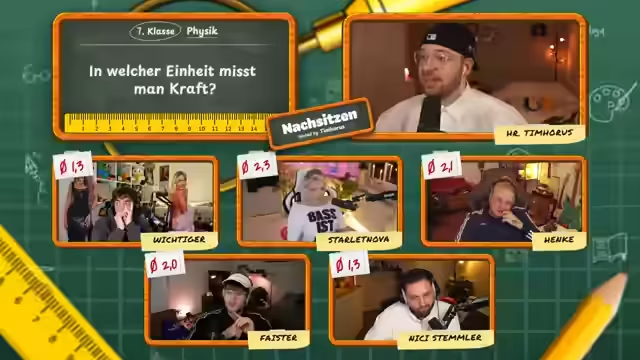
This class includes a German question on the superlative of "viel", which is "am meisten". A history question asks for the founding year of the Federal Republic of Germany, with an allowed tolerance of three years, and the correct answer is 1949. In chemistry, they guess that NaCl is table salt, used in cooking and infusions. The class ends with a physics question about the unit of force, Newton, which one participant gets wrong. The mix of grammar, history, and science keeps the participants on their toes, with some humorous interpretations.
Klasse 8: Geometrie, Kanzler und Stilmittel
01:38:29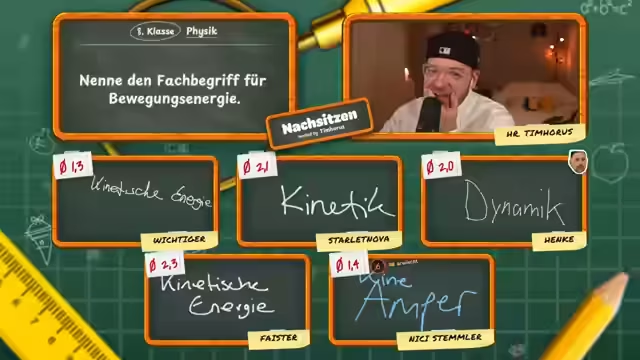
They are asked how many corners an octahedron has, and the correct answer is eight faces, but many guessed six or other numbers. A team task requires naming all German chancellors, which they manage to collectively do, including recent ones like Scholz and Merkel. Then they identify a hyperbole as a stylistic device. A physics question on kinetic energy is answered with "kinetische Energie", but one participant is caught copying, leading to a deduction. The team work becomes more collaborative, and the questions become more challenging.
Klasse 9: Blutgruppen, Pangea und die Mauer
01:45:32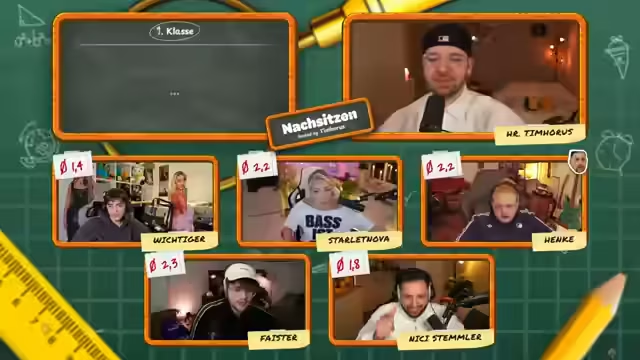
The class starts with a fun task to identify a country on a map, which is easy. In biology, they ask how many blood groups there are, with the correct answer being four main ones. They then learn about Pangea, the supercontinent. A history question asks for the year the Berlin Wall was built, which is 1961, and some participants confuse it with other years. The teacher emphasizes the importance of education, and the participants share personal anecdotes about their own school experiences, adding a relatable and humorous touch.
Klasse 10: Konjunktiv, Bytes und NATO
01:54:42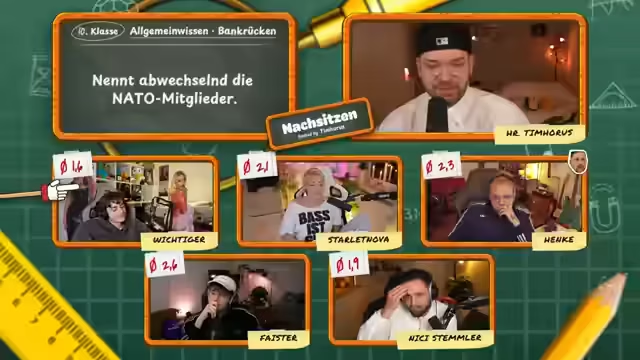
In German, they ask for the Konjunktiv II of "ich bin", which is "ich wäre". An IT question asks how many bits are in a byte, with the answer being 8. They then have a team task listing NATO members, which is challenging with many European countries. The class ends with a physics question about the unit of electrical resistance, which is the ohm, and one participant correctly predicts that Niki would answer incorrectly. The increasing difficulty of the questions leads to more strategic guessing and some playful banter among the group.
Klasse 11: Sternzeichen, Partizip und HTML
02:08:31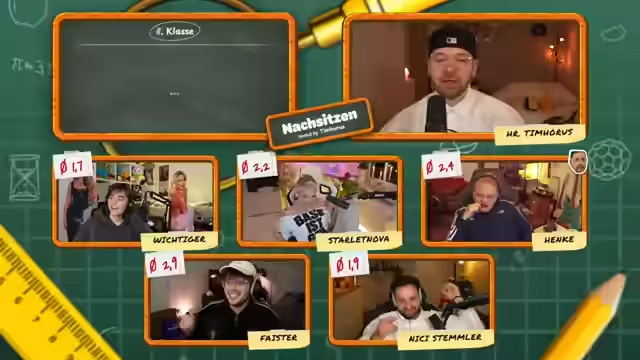
This class begins with a task to name all zodiac signs, which is done collectively. A German question asks for the past participle of "schreiben", which is "geschrieben". An IT question asks for the expansion of HTML, which is Hypertext Markup Language; one participant gets a hint from their roommate. They also discuss the four states of matter: solid, liquid, gas, and plasma, which is a new one for some. The interactions become more complex, and the participants show their strengths and weaknesses in different subjects.
Klasse 12: Zeiten, Exotherm und Fakultät
02:17:26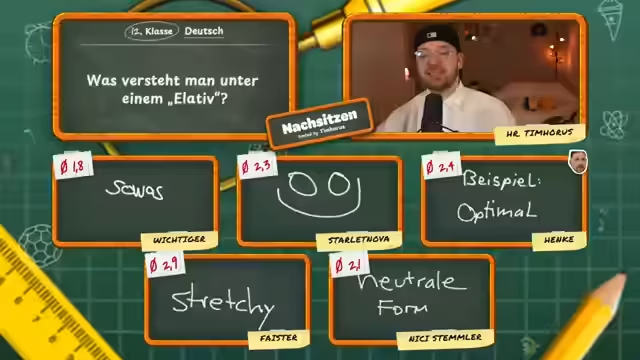
In English, they need to identify the tense of "I have been waiting for you", which is present perfect progressive, but the quiz leader decides to give half points. A chemistry question asks for the term for a reaction that releases heat, which is exothermic. They are stumped by the term "Elativ" in German, which is a superlative without comparison. Finally, a math question asks for 5! (factorial), which is 120, and one participant explains the concept. The final class is the hardest, and the participants struggle but stay engaged.
Zeugnisvergabe und Verabschiedung
02:32:05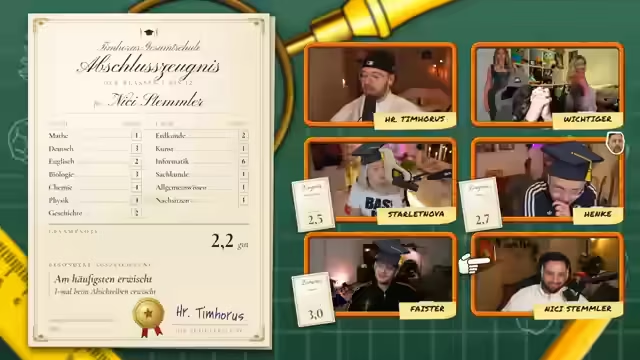
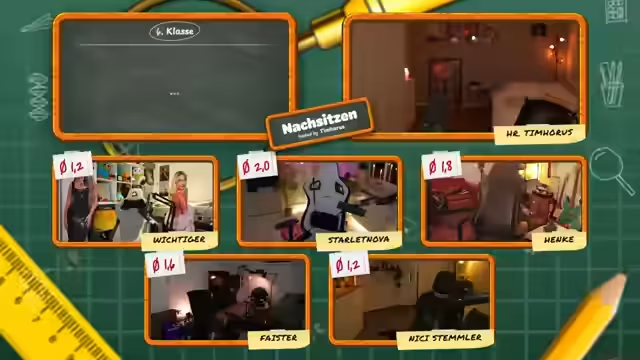
After the last class, the quiz leader asks for the final speech from Wichtiger about toilet paper roll direction, which is met with mixed reactions. Then the certificates are handed out, with each participant receiving a grade in various subjects, leading to an overall average. The class average is 2.5, which is considered decent. The stream ends with thanks and promo for the participants' channels, as well as a reminder to subscribe and leave a like. The participants exchange farewells and the stream concludes shortly after.